

Introduction
The best leather bag manufacturer is not simply the supplier with the lowest quotation or the most polished catalogue. It is the factory that can understand your product brief, turn it into an approvable sample, preserve the agreed materials and construction during production, and provide clear evidence before shipment.
For a buyer comparing factories in China, the evaluation should cover four areas: product-development fit, material and construction control, production quality management, and commercial communication. Ask for evidence that relates to your exact bag category. A factory that performs well with soft fashion totes may not be the right fit for structured briefcases; a supplier experienced in travel bags may use different reinforcement and hardware practices from a small-leather-goods workshop.
This 12-point checklist is designed for retailers, importers and private-label brands. It does not assume that one factory model suits every project. Instead, it helps you build a shortlist, prepare better questions and recognize what still needs to be confirmed in sampling.
Quick answer: what should you check first?
Before selecting a leather bag manufacturer in China, confirm category experience, sample-development capability, leather traceability, construction knowledge, change control, in-process inspection, final inspection, packaging control and communication ownership. Review a physical sample against a written specification. Treat quoted MOQ, price and schedule as project-specific until the material, design and packaging are defined.
1. Start with category fit, not a generic “bag factory” label
“Leather bags” covers very different products. A soft tote, a structured handbag, a laptop backpack, a travel duffle and a bifold wallet place different demands on patterns, reinforcement, machinery and workmanship.
Ask the supplier which categories it develops regularly and request examples that are close to your intended construction—not copies of another brand, but evidence of comparable techniques. For a travel bag, look for experience with load-bearing handles, detachable straps, zipper installation and base reinforcement. For a wallet, inspect thin skiving, pocket alignment, fold behavior and edge finishing. For a structured handbag, focus on panel symmetry, reinforcement, shape retention and clean hardware placement.
A relevant product example is more useful than a large but unrelated catalogue.
2. Evaluate how the factory reads a brief
A capable development team should identify missing information before quoting a final production plan. Send the same concise brief to shortlisted suppliers and compare the questions they ask.
At minimum, your brief should include:
- product category and intended use;
- reference dimensions and capacity;
- target market and retail positioning;
- leather type or desired appearance and hand feel;
- lining, hardware and color direction;
- logo artwork and preferred branding method;
- packaging concept;
- expected order volume for quotation purposes;
- any market-specific testing or documentation requirements.
Good questions from a factory are a positive signal. If the team asks about leather temper, reinforcement at stress points, acceptable natural variation, logo scale or packaging protection, it is working toward a manufacturable specification rather than guessing.
3. Confirm sample-development capability
Sampling is where a design becomes a production reference. Ask who reviews patterns, how material alternatives are communicated and how revisions are recorded. The factory should be able to explain the difference between a visual prototype, a fit or function sample, and a final pre-production sample.
Do not approve a sample based only on photographs. A physical review should include dimensions, capacity, opening access, strap comfort, pocket use, zipper movement, hardware operation and the loaded shape of the bag. Photograph agreed details and keep a revision log. If you approve a change in a chat message, add it to the controlled specification as well.
In practical factory work, small changes interact. Increasing leather thickness can alter folded edges and seam bulk. Moving a pocket can affect reinforcement. Changing hardware may require a different opening, washer or backing layer. A supplier should identify these dependencies before bulk production.
4. Define the leather beyond its marketing name
Terms such as full-grain, top-grain, Crazy Horse or genuine leather do not fully specify the material. A usable leather standard also covers animal type, tanning or finishing direction, thickness range, temper, color, gloss, grain character, backing and acceptable natural marks.
Approve a leather swatch or cutting under consistent lighting. Note which variations are acceptable for visible panels and which areas can use less visually uniform sections. Confirm whether the factory can maintain the selected article and color for reorders, while recognizing that natural leather can vary between hides and dye lots.
Where performance or market compliance matters, define the required test method and pass criteria with a qualified laboratory or compliance adviser. ASTM publishes leather methods for properties including crocking, tensile performance and finish flexibility. The appropriate test depends on the product, leather finish and destination market; a method name is not a substitute for a buyer-approved requirement.
5. Inspect construction knowledge at stress points
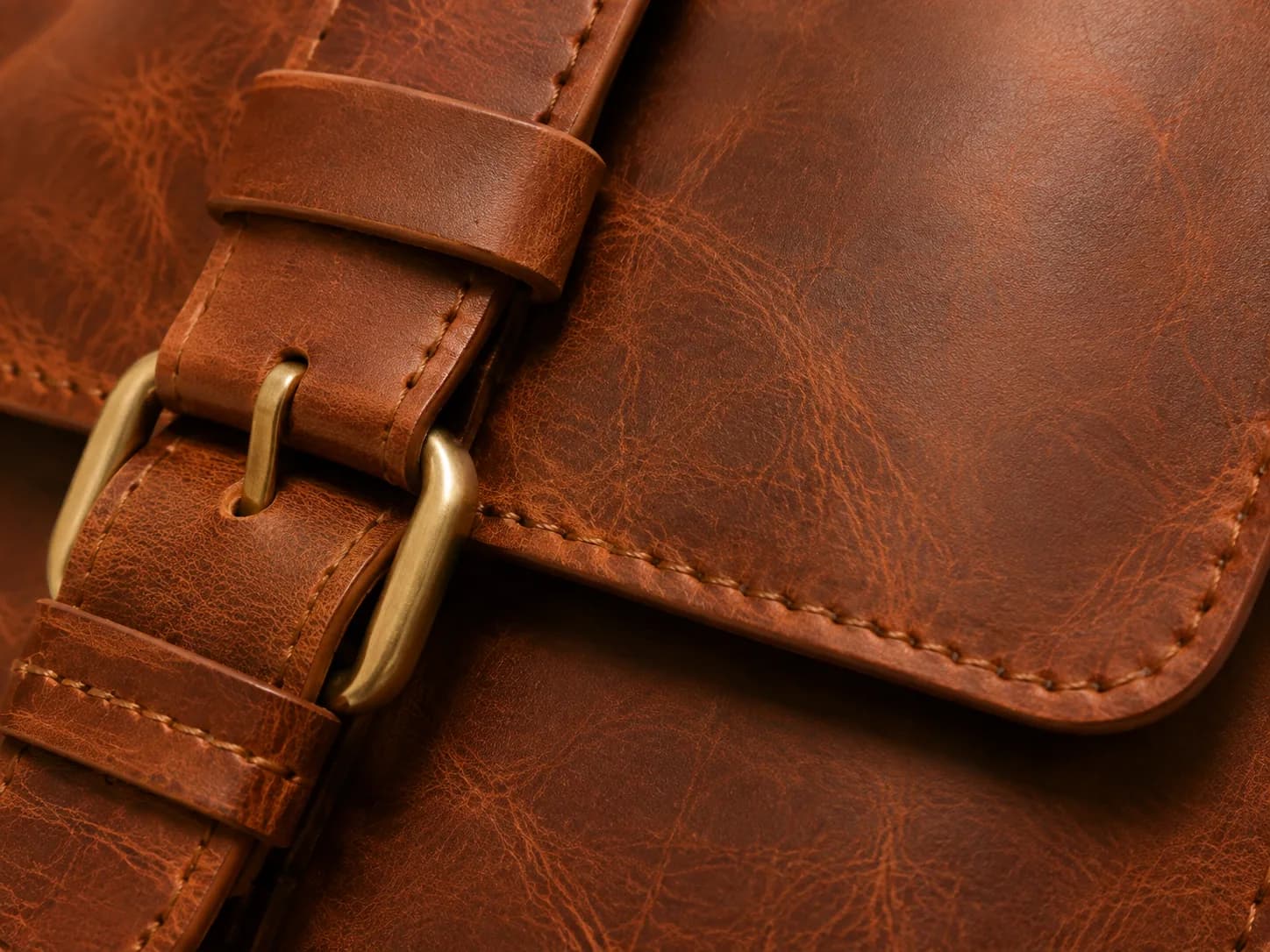
Ask the factory to explain how load travels through the product. On a shoulder or travel bag, handle roots, strap anchors, D-rings, zipper ends, side seams and the base usually deserve special attention. Reinforcement should be compatible with the leather and hidden without creating hard ridges or premature wear.
Review:
- seam allowance and stitch position;
- stitch density and thread selection;
- skiving transitions at folded areas;
- reinforcement material and coverage;
- edge construction and finishing;
- zipper tape support and end stops;
- hardware backing and alignment;
- lining attachment and pocket access.
The goal is not to impose one construction method on every bag. It is to make the chosen method visible, reviewable and repeatable.
6. Check whether the bill of materials is controlled
A bill of materials, or BOM, lists the components approved for production: leather, lining, reinforcement, thread, zipper, hardware, labels and packaging. Ask how the supplier prevents unapproved substitutions.
For visually similar parts, record functional details. A buckle description might include dimensions, base material, finish color, logo treatment and mating strap width. A zipper record may include type, size, tape color, slider and puller. Packaging should specify each protective layer, label and carton mark.
If an approved component becomes unavailable, the replacement should go through written review rather than appearing for the first time during shipment inspection.
7. Look for in-process quality control, not only a final check
Final inspection can find defects, but it cannot efficiently correct every upstream cause. Ask which checks happen before cutting and during production.
A practical control flow may include incoming material review, cutting-part checks, first-piece confirmation, stitching and assembly checks, logo-position verification, hardware function checks, cleaning, final inspection and packing review. The exact checkpoints should reflect the product. A complex structured handbag needs different controls from a simple card holder.
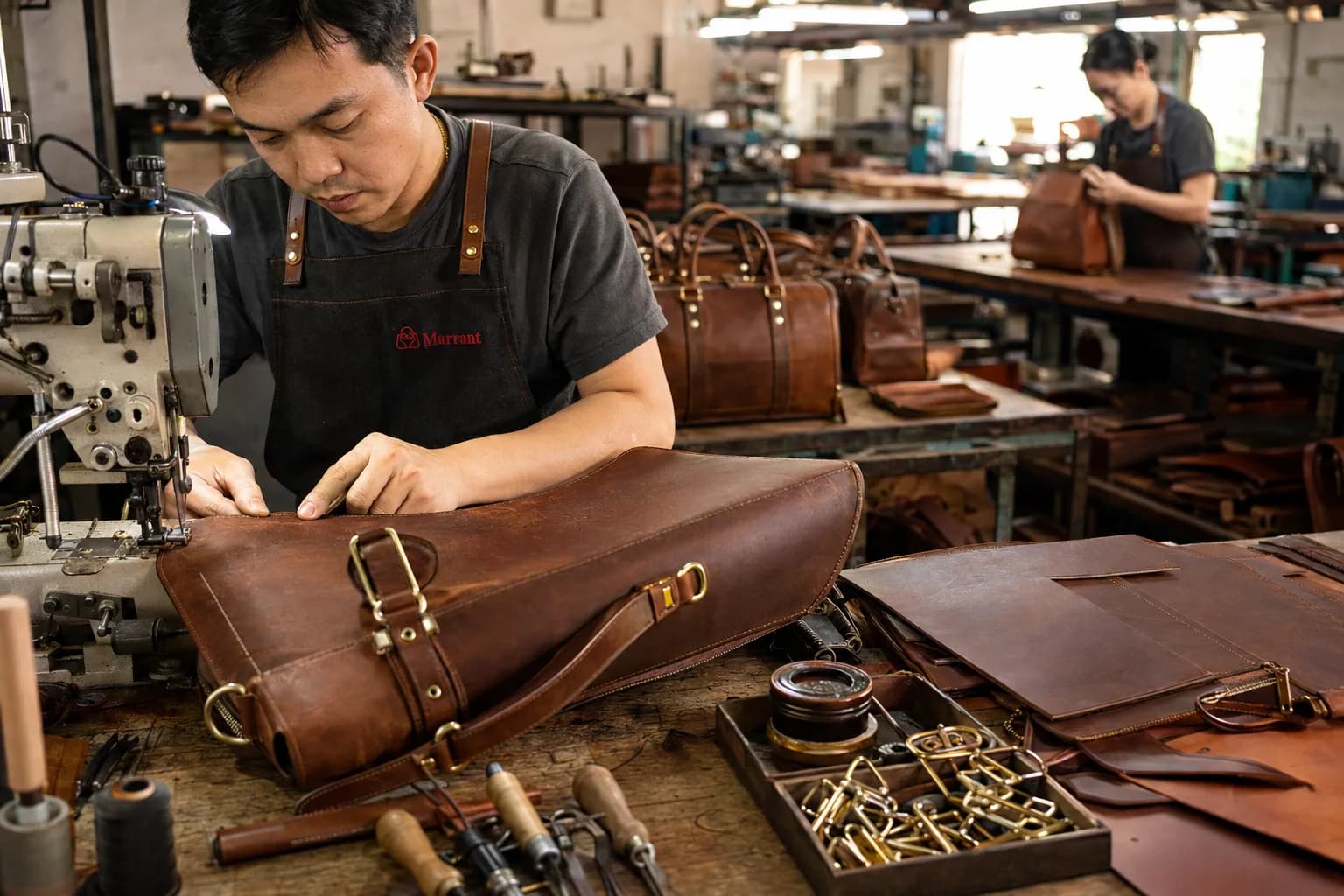
Marrant's published workflow emphasizes material inspection before cutting, key in-process checks and final inspection before packing. During a factory visit or video review, ask to see how those checkpoints are recorded for your project rather than relying on a generic quality statement.
8. Agree on the golden sample and written tolerances
The approved pre-production sample is often called the golden sample. It should work together with the specification, BOM, artwork and packaging instructions. A sample alone cannot define everything because leather varies naturally and some dimensions need an acceptable range.
Write measurable requirements only where they matter. Examples include overall dimensions, strap length, logo position, pocket opening and hardware alignment. Do not copy arbitrary tolerances from another product. A tolerance must reflect the pattern, material behavior, user function and your quality risk.
Keep one approved sample with the buyer and one controlled reference with the factory. Mark both clearly so they are not confused with earlier prototypes.
9. Ask how changes are controlled
Late changes create risk when information is scattered across email, messaging apps and annotated photographs. Ask for one revision owner and one current specification pack.
Each change record should state what changed, why, which sample or document shows it, who approved it and whether it affects price, material availability or schedule. Before production, issue a final confirmation that supersedes earlier versions. During production, require approval before any material or construction substitution.
This discipline matters more than the software used. A simple numbered PDF and change log can work well if both teams consistently use them.
10. Review communication and problem ownership
Fast replies are helpful, but decision quality matters more. Evaluate whether the contact person answers the actual question, distinguishes confirmed facts from estimates and escalates technical issues to the right colleague.
Use a small test during supplier selection: send three questions about construction, material and packaging. Check whether the response is complete, whether assumptions are labeled and whether unresolved points are tracked. Ask who will own communication during sampling, production and shipment preparation.
A reliable supplier should be comfortable saying “to be confirmed” when evidence is not yet available. False certainty at the quotation stage often creates disputes later.
11. Plan shipment inspection before production starts
Define the inspection approach in the purchase agreement or quality plan. Decide who inspects, when the goods are considered ready, which documents and approved references are used, how samples are selected, what counts as a critical, major or minor defect, and how failed findings are handled.
For lot-by-lot attribute inspection, buyers may choose a recognized acceptance-sampling system. ISO 2859-1:2026 describes AQL-indexed sampling schemes, but the standard does not choose your defect definitions or commercial acceptance level. Those decisions must be agreed for the product and risk. AQL is not a promise that every shipped item is defect-free.
Inspection should also cover assortment, quantity, labeling, barcode data where applicable, protective packing, carton condition and shipping marks—not just the appearance of the bag.

12. Compare the complete commercial proposal
The lowest unit price can exclude important items. Compare quotations on the same basis:
- exact material and hardware assumptions;
- sample scope and revision terms;
- logo tooling or setup;
- packaging components;
- testing or third-party inspection responsibility;
- trade terms and shipment handover point;
- payment milestones;
- treatment of approved changes;
- reorder assumptions.
MOQ and lead time should remain project-specific until the final material, construction, color range, branding and packaging are understood. Ask the supplier to separate confirmed items from provisional assumptions.
Factory verification questions to ask
- Which of our product's construction methods do you perform regularly?
- Who reviews the tech pack and owns sample revisions?
- How do you approve and identify production leather?
- Which components are purchased externally, and how are substitutions controlled?
- What is checked before cutting, during assembly and before packing?
- How is the approved sample stored and used on the production floor?
- Can we review production and quality checkpoints during a visit or live video call?
- Who receives and closes corrective actions if inspection finds a problem?
Common warning signs
Be cautious when a supplier gives a firm production answer before reviewing the design; avoids showing category-relevant work; cannot distinguish the current sample revision; treats natural leather variation as either “no variation” or “anything is acceptable”; changes materials without written approval; or promises that final inspection alone will guarantee quality.
None of these signs automatically proves bad intent. They show that the project needs clearer evidence before commitment.
FAQ
Is it better to work directly with a leather bag factory or a trading company?
Neither model is automatically better. A direct factory can shorten technical communication, while a capable trading or sourcing team may coordinate multiple materials and categories. Verify who actually develops and manufactures the product, who controls quality, and who is contractually responsible for problems.
What documents should I send for a custom leather bag quotation?
Send dimensions, views or drawings, materials, construction notes, logo artwork, hardware direction, lining, packaging, target market and estimated quantity. Mark unknown items clearly so the factory can propose options instead of silently assuming.
Can factory photos prove that a supplier manufactures the bags?
Photos provide context but are not conclusive. Combine them with a live walkthrough or visit, category-specific sample review, technical discussion, business verification and a controlled trial project.
Should I request a factory audit?
Consider an audit when order value, compliance exposure, product complexity or continuity risk justifies it. Define the audit scope around your needs, such as capability, quality systems, social requirements or supply-chain controls. Do not treat one certificate or checklist as proof of every capability.
How many samples should I make before production?
There is no universal number. The required rounds depend on how complete the brief is, how original the construction is and whether material or function changes are needed. Do not begin bulk production until the final sample and current specification are aligned.
What is the most important question to ask a leather bag manufacturer?
Ask: “How will you ensure bulk production matches the approved sample and written specification?” The answer should cover materials, change control, in-process checks, final inspection and responsibility for corrective action.
Conclusion
Choosing a leather bag manufacturer in China is an evidence-gathering process. Start with category fit, then test how the supplier handles a brief, sample revisions, leather standards, construction details, component control and quality checkpoints. Put the final decisions into a controlled specification and plan shipment inspection before production begins.
The strongest supplier relationship is not built on confident promises. It is built on clear requirements, visible decisions and repeatable checks.